Posts Tagged ‘Literature’

To Read, Not To Read Or Not Quite Finish Reading

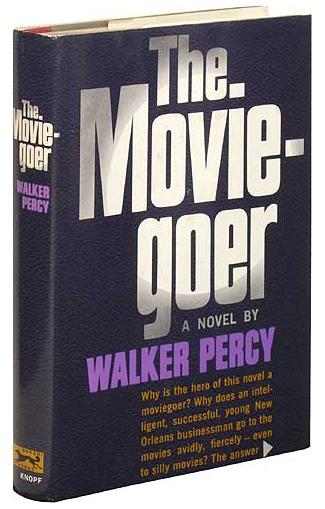
I feel I have a pretty good success rate with the books I choose to read. By that I mean I enjoy the majority of books I get lost in and have had a pretty good run of things recently. Whether it be fiction or non fiction, I have chosen wisely and been satisfied as a result. However, there are the ones which you devote time to but after around 100 pages have the inkling that it’s not quite living up to your expectations. I am in this place at the moment with The Moviegoer by Walker Percy. Things had looked good before embarking on this National Book Award winner for fiction in 1962. Firstly, the protagonist likes going to the movies so for a kick off there is something I can identify with and secondly on attempting to buy it in a central London book store I was told it wasn’t in stock but the chap serving me was keen to state that it wasn’t just a great story but his favourite book of all time. I think if I had invited him back to mine for an impromptu book group session he would have accepted but as we had just met, I thought it unwise to do so and besides I was in the mood for some record shopping after I had acquired the book. He was however very keen for me to track it down and this I did. Alas, it has failed to sparkle. This is obviously not a feeling shared with The Guardian who labelled it “Sharp, witty and profound” or The Times who state it is “A modern classic… wry and lyrical”. I would simply label it “well enough written, not as gripping as I had hoped and if I want wry and lyrical in the future I’ll dig out The Best Of Leonard Cohen”.

I did contemplate casting it aside and beginning something else but have decided to plod on to the end as it isn’t a long read, 242 pages to be precise. I had the same inclination when watching  Scorsese‘s Shutter Island at the cinema earlier this year and while I would like to say I was glad I stayed to the end, all it served to do was prolong my disappointment with the film and wonder how such a great director could put his name to a piece of work that did so little for me. I am fully aware many others would not share this opinion.

The last book I neglected to finish was George Gissing‘s (pictured above)  New Grub Street but it wasn’t because I wasn’t enjoying it. I just got side tracked by some other books and fully intend to finish it at some point soon. The theme of artistic creativity over commercial gain is always an interesting one especially when applied to writers as it is in New Grub Street. It’s also a theme that anyone involved in the arts has to deal with at some point or other.

Regardless of how enjoyable and easy certain books are to digest compared to others, they all still require a concerted effort and one always hopes the effort is worthwhile. My question is, how far should you get in to a book before realising that continuing is futile and it would be better to start a new one? Conversely, is it the case that one should persevere in the hope that at the very least there will be some sense of achievement on completion? I hold out more hope for the next page turner I have lined up – a second hand copy of Let It Blurt: The Life And Times Of Lester Bangs. I can’t see that being tossed aside by page 70 or indeed 170. In fact on completition it may be the apt moment to reacquaint myself with Mr Gissing.

Image 1 – Cambridge Forecast

Image 2 – Alison Anderson

The Big Triumvirate – Football, Culture and Nostalgia

I’ve been listening to quite a few debates on the radio recently concerning The World Cup and in particular the proposed introduction of goal line technology. I’m all for it as the absence of it has shown the multi-million pound tournament to be a tad farcical as a result. There have been many other debates flying around especially after England‘s exit at the hands of Germany. The whole country has been in a state of disbelief as to how such a bunch of talented players can’t perform on the world stage which has in turn led to a bout of national depression. As a Scot this is something I can fully empathise with. When Scotland have qualified for major tournaments in the past, they have gone there with hope and expectation which ultimately lead to failure and disappointment.

It’s at times such as these that culture can become even more of a trusted friend. Quite simply, a great album, book or film will never let you down. Conversely, a football team, even if you are Brazilian, will. I’m not sure how the millions who watched England being eliminated from the World Cup dealt with the blow of being dumped out the cup to a superior German side but I would imagine plenty alcohol was used as a crutch. This is fine for a short period of time but as Morrissey so presciently put it – “I was happy in the haze of a drunken hour, but heaven knows I’m miserable now”. I have walked home from watching football matches in the past with a hangover kicking in after seeing my team lose. It’s not a lot of fun. Over time I have learned to go straight for a piece of art that keeps on giving. It might be Forever Changes by Love or Marquee Moon by Television. It could be a dvd of All The President’s Men or The Lives Of Others. It may be a battered old copy of L’Etranger by Albert Camus or a relatively new copy of John Niven‘s Kill Your Friends. Point being, these examples and countless others will not let you down at any time but are especially welcome when dealing with sporting disaster. I hope this helps at least some of those who are despondent at their teams premature exit from the World Cup. There is another avenue to go down for comfort and that is nostalgia. Harking back to a time when your team were much better is understandable and it got me thinking about some of the things I miss about the football of yesteryear. Here are three examples -

1. I miss walking to a football ground as a young kid and getting a rush of excitement at the first sight of floodlight pylons in the distance, such as those of the old Hampden Park below.

2. I miss the design classic that was the Adidas Tango football. Still the greatest match ball ever.

3. I miss the fact that there was a time when you could buy replica football tops that weren’t emblazoned with a sponsors name thus maintaining a simplistic yet cool aesthetic.

Image 1 – www.urbanglasgow.co.uk

Image 2 – www.doncastergraphicdesign.com

Image 3 – www.oldfootballshirts.com

Never Judge A Book By Its Cover… Unless It’s John Fante

I have mentioned the work of John Fante a few times on this blog with particular reference made to the fact that he is one of my favourite American authors. On more than one occasion when I have been in the company of friends and had a novel of his on my person, it has been remarked that the covers of his books are rather impressive. I think this is due to the simplicity of them and as a result the “less is more” cool visual aesthetic of them. So, as much as we are told never to judge a book by its cover, in the case of Fante, exceptions can be made. By way of some visual literary celebration, and lets face it who doesn’t need some VLC from time to time, here are the four covers of the novels that centre on the life of protagonist Arturo Bandini, collectively known as The Bandini Quartet.

Wait Until Spring, Bandini

The Road To Los Angeles

Ask The Dust

Dreams From Bunker Hill

Image 1 – The Mookse and the Gripes

Image 2 – Justin Mitchell

Image 3 – The Gulf Scream

Image 4 – Happy Hour Lit

In Appreciation of… Harvey Pekar and American Splendor

Like many I had never heard of Harvey Pekar before watching the film American Splendor. I went to see it on a cold and grey January afternoon in 2004 after scouring the cinema listings in the hope there would be something I could immerse myself in for a couple of hours. Having read an outline of a film concerning a comic book writer who shuns super heroes in order to document everyday life I was suitably intrigued. I was also taken by the movies tag line “Ordinary life is pretty complex stuff” as I have often felt that the minutiae of day to day living can make for a rich source of material to incorporate in artistic endeavors. Obvious proof of this can be found in many of Larry David‘s exploits in Curb Your Enthusiasm and in the work of Ricky Gervais. However, Pekar shuns the big comic pay offs for more subtle and reflective stories.

The film is perfectly cast with Paul Giamatti playing Harvey and Hope Davis his second wife Joyce. When it was released Giamatti had yet to achieve the level of fame afforded to him by his commercial breakthrough role in Sideways. At the time he was a highly talented character actor and one whom I had long admired for performances in movies such as Storytelling, Safe Men and Man on the Moon.

As I sat in the cinema that day I became more immersed in the story of a man I knew nothing about after every passing minute. It was strangely exhilarating  to see how a file clerk produced his own comic book series which the ordinary man could empathise with. Moreover, the author still couldn’t afford to give up his ordinary job as the kudos gained from his publication didn’t translate into megabucks.  I also loved the way it was shot using comic book graphics and the way the real Harvey and Joyce (along with genuine nerd Toby Radloff) appeared as themselves  discussing how it felt being portrayed by actors. I could go on and examine all the elements I feel make this film my favourite of the last ten years but this is not a film review and besides, there are many crits of the movie to be found online. There is a particularly interesting one written by American cultural commentator Jaime Wolf  back in 2003 comparing and contrasting Splendor with the mighty Annie Hall. It’s an interesting comparison written originally for Slate Magazine.

After seeing the movie I made it my mission to read as much of Pekar’s writing I could possibly get my hands on. This wasn’t easy though as when the film was released there was only one Pekar anthology easily available in the UK. Thankfully in subsequent years more material has been published. I immediately became engrossed with my first Splendor anthology but must admit to being slightly taken aback at the sheer mundanity of some of the topics for stories. There were stories about losing and finding one’s reading glasses, getting up early to avoid traffic jams and tales of someone jamming their hand in a filing cabinet at work. The thing is, I loved these stories as there was a charm and warmth which left the reader rooting for the protagonist as he tries to finish another day on the winning side. It would be unfair to suggest Pekar just concentrates on the more banal aspects of life. There were other stories not even concerning him and this adds to his strength as a cultural commentator. He is adept in reviewing the work of writers and jazz musicians not just in American Splendor but in other publications which unfortunately are almost impossible to find in the UK.

Aside from a growing number of anthologies there is Our Movie Year which documents how the film came to be made and the acclaim heaped upon it on release. At one stage in this book Pekar documents his trip to the Edinburgh International Film Festival for the films British premiere. It felt bizarre to see Scotland featuring in a comic book story normally set in Cleveland, Ohio but strangely apt that I was reading about the man being in the city where I first discovered his existence. More solemnly, Our Cancer Year first published in 1994 documents Pekar’s diagnosis and eventual conquering of cancer. This, as the subject matter suggests, is not the lightest of reads but an important and inspiring volume. Having fought and won the most important battle of his life Pekar returned to more familiar territory in the companion pieces Another Day and Another Dollar. He also found time to write about his childhood in The Quitter, an offering the New York Post deemed “an achingly poignant tale”.

As much as I relish reading such personal reminisces I equally enjoy Pekar’s appraisals on literature and music . One recent example is the 2009 publication of The Beats: A Graphic History. Along with Ed Piskor and several others Pekar examines the lives and works of not just the most famous of the Beat generation writers (Kerouac, Burroughs and Ginsberg) but also some of the lesser known players in the movement such as Michael McClure, Lawrence Ferlinghetti and Kenneth Patchen. As ever the writing is complimented by excellent illustrations helping to create a great literary companion piece for fans of the writers contained but also a great introduction to the them for the uninitiated.

Now in his seventies Pekar is still documenting the ordinary yet complex aspects of everyday life as he sees them. I would imagine the film also continues to sell enough copies on dvd to introduce a sufficient number of new fans to the man and his work. For me, one of the key strengths of Pekar’s story is its highlighting of the fact that there are many out there who have creative urges but are unsure how such leanings could manifest themselves. This is illustrated in the film with Harvey’s frustrations at his own writing ambitions which eventually lead to something of a creative epiphany as he spends a whole night writing about the mundanities he has to face on a daily basis which then gain approval from his friend and comic artist Robert Crumb, who offers to illustrate the stories for him. This eventual artistic emancipation is inspiring to people in the way that punk music was to those in the seventies who looked at progressive rock musicians and thought “I’ll never be good enough to play a twenty minute keyboard solo but I could just about learn three chords and write a song which in some way documents how I’m feeling”. I’m not sure if this is the first time Pekar’s work has been compared with the original punk/diy ethos but as the film has already been somewhat surprisingly compared with Annie Hall it seems some way justifiable. I’m sure Harvey wouldn’t mind especially as I’ll leave a closing comment of final admiration. Credit should go to Pekar for identifying a gap in the comic book market as a champion of life’s daily struggles. He is a true original in that respect.

Image 1 – Ty Templeton’s Art Land

Image 2 – Jazzwax.com

A Couple Of Book Recommendations

We are careering towards the middle of the year quicker than I had expected so I thought it high time to pop in with a couple of book recommendations for anyone in need of some new reading material. The first is Ask The Dust by one of my favourite writers John Fante. It’s one of four novels which comprise the Bandini Quartet which all centre on various stages in the life of protagonist Arturo Bandini. In the opinion of most fans of his work Ask The Dust is the best of the four although all are worth reading. One person who certainly thought so was Charles Bukowski who once claimed “Written of and from the gut and heart… Fante was my god”.

The second is Nick Kent‘s tremendous Apathy For The Devil:A 1970′s Memoir. Suffice to say, if you are in any way interested in some of the greatest music ever made, journalism, drug debauchery and redemption then this is a book well worth reading. One of the strengths is Kent’s honest writing and recollection. As much as I enjoyed his selected writings in The Dark Stuff, I enjoyed this more which is in no small measure down to the anecdotes contained which have the perfect mix of wit and candour.

Image 1 – E-Verse Radio

Image 2 – The Cultural Pick