Posts Tagged ‘dougie anderson’

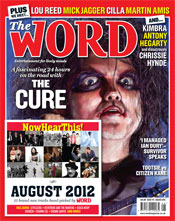
The Word Magazine – It Shall Be Missed

I knew the day was coming a couple of weeks ago when I read on the magazines web site that the next edition of The Word would be the last and so when I handed over my money at WH Smith’s this morning, it was with some sadness. The variety of large chocolate bars on offer for one pound a piece in the shop did nothing to cushion the blow and besides, I never have much of a sweet tooth that early in the morning.

As Mark Ellen details in his last editorial, the current economic climate, competition with free media and the erosion of traditional advertising have made it impossible to sustain the publication. To quote Captain Darling from the final episode of Blackadder Goes Fourth when he too finds out that he’ll be going over the top,  – “Buggar”.

A couple of years ago I wrote a piece about why I thought Word was the best magazine around and nothing has changed my opinion since. The article can be found here and in fact led me to appearing on the highly regarded Word Podcast with Mark Ellen and David Hepworth. A most enjoyable hour it was too where amongst other things I argued the merits of Belle&Sebastian whom I had recently been working with, discussed various Scottish World Cup songs and even got in a mention of one of my favourite songwriters who has never got the attention he deserved, Bob Lind. The conversation we had that day in a room with no windows was the kind I could happily have any day of the week albeit with the hope that some of them might be in a room with a view. The podcast can be heard here. I also have Mark and David to thank for helping the promotion of my short film Timber! by way of including it in the Links We Like section of the weekly Word Newsletter and for giving me shelter at last years rain soaked Latitude Festival in the little Word Tent. I would later go back there for some free alcoholic punch which helped me no end in getting through the weekend in a windcheater not equipped to handle the conditions. Thank you gents, it made all the difference.

I always saw, along with many others in “The Word Massive” that the magazine was in tune with my musical and cultural tastes and this is again the case with the final edition. There is mention of one of my favourite albums, Nick Garrie‘s 1969 masterpiece The Nightmare of J.B. Stanislas, an article by Eamonn Forde on the art and science of the setlist and some great archive photos of my favourite band of them all, The Rolling Stones. I’ll enjoy those and more while perhaps even reading a little slower this time in the knowledge that this is indeed it. As Kurt Vonnegut would say, “so it goes… ” but as I would add, all too soon.

Cathedrals For The Masses – The World Of The Football Stadium

Since I visited my first in 1983 as a very young boy, I have been somewhat in awe of football stadiums. It’s not something I’m particularly proud about nor ashamed, it is simply the case. I was taken along with my father and grandfather to see Hibernian play Aberdeen at Easter Road Stadium in Edinburgh on a cold October afternoon but before the teams even took to the field I was already marveling at the massed banks of terracing, floodlights and even the electronic scoreboard which didn’t work and would never work on all my return visits, of which there were many. It was actually a strange introduction to football as Hibs won 2-1 against an Aberdeen side managed by Alex Ferguson and who were at the time, the European Cup Winners Cup holders. As I was to quickly find out, seeing Hibs win wasn’t a regular experience but you have your team and you stick with them through thin and thinner. As I always say, being a Hibs and Scotland fan from an early age helps to harden your skin for the inevitable disappointments later life can throw at you. There is some tremendous archive footage of Easter Road taken in 1980 and can be seen here, the fact that it’s soundtracked by the Mogwai classic Hunted By A Freak is somewhat of an extra bonus.

Only two years later I would again see the two teams play one another but this time it was in the League Cup Final at Hampden Park. As far as the the actual game was concerned, it could only be described as an unmitigated disaster. Inside the first 12 minutes we were two nil down and would go on to lose three nil. This was obviously extremely disappointing for me and the many, many thousands of others who had travelled through from Edinburgh. However, on the plus side, the national stadium was a breathtaking sight to behold. It was no longer the biggest in the world as it had been before the Maracana was re-developed in Brazil but to a small child’s eyes and I’m sure a great many adult ones it still looked mightily impressive. It was huge, foreboding even, but totally captivating and the details all around intrigued me. The height of the floodlights, the massive roof covering one terrace behind the goal, the press box on top of the main stand which seemed to hang there regardless of the laws of gravity, the crush barriers on the terracing and the stanchions attached to the goalposts. I didn’t know at the time but I was in a city which at one point could claim to have the three biggest stadiums in the world (the other two being Celtic Park and Ibrox) and which was also the birthplace of Archibald Leitch, the pioneer of British stadium design. I didn’t need this extra information at the time to make the visual experience any more exhilarating however.

Although the stadiums I once visited no longer exist in their previous form due to vital modernisation they still hold a special place in my heart and I believe, an importance for society as a whole. Of all the buildings in the public realm, stadiums enjoy the highest profile – millions of people across the world worship at them every week, far more than can be found attending churches. But what do we really know about them and what makes a stadium special? Today the football ground can be regarded as among the most important buildings a city possesses. The stadium is much more than just steel framework, bricks and mortar – it embodies a club’s history, many of its major triumphs and disasters and is often as familiar to the fan as his or her local high street whilst providing a focus for the community. On a global scale, they act as symbols for a nation. Their architectural features can be viewed in the same light as a cathedral and can cause as much controversy as the latest modern sculpture to be discussed and dissected in the media. In recent history such celebrated architectural feats as the “Gherkin” building in London, the Scottish Parliament building in Edinburgh and the Millennium Centre in Cardiff ultimately lack the profound effect the stadium architects continue to have on the Britons who inhabit their structures. They are seen by many more on television in all corners of the planet while a game is being played but there are still many areas of interest to unearth long after the whistle has blown and the spectators have gone home.

Firstly there are the architectural and historical factors to take in to consideration such as the fact that some stadiums, or at least certain parts of them have acquired the status of listed buildings. Therein lies the reason that although Arsenal no longer play at Highbury the two main stands have been converted in to housing as opposed to being demolished. Then there is the sociological, why did certain areas of certain stadiums produce better atmospheres than others? Aside from perhaps the most obvious example of The Kop in Liverpool there was also The Jungle at Celtic Park and the Shelf at White Hart Lane to name just two more, there are countless others of course. Next there is the psychological, the idea of grounds as fortresses and the intimidation factors generated. It is perhaps unsurprising but not widely reported that the design of a ground can help or hinder the affect of the referee. This is examined in a Salford University research paper entitled “How stadium design affects football results” and details that if fans are further away from the pitch due to a running track, they are unable to exert as much psychological pressure on the referee than if they were closer. Lastly there is the political. The recent arguments over who should occupy the Olympic Stadium after the 2012 games in London ended up going straight to the heart of government. Before this and due to the disasters at Heysel, Bradford and Hillsborough, political legislation has had huge affect on the stadiums of the UK and beyond.

All areas of the UK have their own individual stadium stories and histories. To take one such area as an example, the north west of England, it becomes evident that the stories are as interesting as they are varied. For instance, Manchester United‘s Old Trafford has appeared in more feature films than any other British club ground. These films include  Charlie Bubbles starring Albert Finney (1968), Hell Is A City, with Stanley Baker and Donald Pleasance (1960), Billy Liar, starring Tom Courtenay and Julie Christie (1963) and The Lovers with Richard Beckinsale and Paula Wilcox (1972).  Less favourably, and going back a little further, this was also a club who in 1910 were christened “Moneybags United” due in part to other peoples jealousy as the ground contained a billiard room, massage room, a gymnasium, a plunge bath, a capacity of 80,000 and attendants to lead patrons to their five shilling tip up seats from the tea-rooms.

While Liverpool FC couldn’t quite boast the material wealth of their great rivals they are a club where the political and psychological aspects of football stadiums are intrinsically linked. In the history of stadium disasters Liverpool have been at the centre of two of the worst – Heysel and Hillsborough. Aside from the obvious emotional ramifications the disasters also had a huge affect on Anfield itself. For one it has meant that the most famous terrace in British football, The Kop, is now all seated.  It is also a terrace with a strange nautical history. When the Kop was extended and covered in 1928, the Kemlyn Road corner of the terrace saw a new landmark installed. It was a tall white flagpole, which had been the top mast of The Great Eastern, one of the first iron ships in the world whose maiden voyage was in 1860 but by 1888 lay broken up in the Mersey docks. When the Kop was completed, the surviving top mast was floated across the Mersey and hauled up to Anfield by a team of horses proving that re-cycling was happening long before the council decided to hand out bags to each household by way of an incentive for green living.

More strange yet fascinating stories can be found across Stanley Park at the home of Everton, Goodison Park. In 1913 the ground became the first to be visited by a ruling monarch when George V and Queen Mary came to inspect local school children there. Soon after the First World War the US baseball teams Chicago White Sox and the New York Giants played an exhibition match at the ground with one player managing to hit a ball straight over the main stand. The club even dealt with the problem of housing in close proximity to the ground in a swift and decisive way. In preparation for 1966 World Cup, they bought and demolished some terraced houses behind the Park End Stand in order to build a new entrance. A quick yet pragmatic action indeed. Famously, at one corner of the ground sits a church, St Luke the Evangelist. Proof if it were needed that the football stadium hasn’t completely replaced the church as the heart and focal point of the community.

The one complaint that some Evertonians may have nowadays is that although their stadium has maintained a traditional appearance, the old fashioned nature of Goodison doesn’t exactly lend itself to comfort and uninterrupted views. Conversely, a club who have seen a monumental volte-face in terms of spectator comfort and environs are Bolton Wanderers. Where now a Bolton Wanderers fan can marvel at the futuristic Reebok Stadium, the memory of the old Burnden Park is still vivid in many of their minds and was also immortalized in the L.S. Lowry painting Going To The Match. Furthermore, this was a ground where in its last few functioning seasons until demolition in 1999 had a brand new supermarket replace the traditional terrace behind one of the goals and begs the question, did supporters buy their groceries before or after taking in a match?

There are of course many more tales to uncover from football grounds not just in the north west of England but all over the UK and beyond. For those  seeking more information I would always direct them firstly to the excellent Football Grounds Of Great Britain by Simon Inglis and his follow up books The Football Grounds of Europe and Engineering Archie: Archibald Leitch – Football Ground Designer. There are also many web sites dedicated to football stadiums old and new with a good first port of call being The Football Ground Guide which contains information on existing stadiums, pictures and retrospectives on old ones and a message board for users to discuss all aspects of football ground culture. It was while browsing this busy message board some time ago that I realised I wasn’t alone in my secret passion, not alone by a long stretch.

Image – Football Ground Guide

Belle & Sebastian Write About Love – The TV Show

So here it is, The Belle & Sebastian TV Show which I hosted and also played the role of the band’s pragmatic managerial type person. It’s not often I have more than one role in a TV show but it was thoroughly enjoyable to have the opportunity on this occasion. Alas, I’m still somewhat lagging behind Sellers‘s four roles in Dr Strangelove although I do own the soundtrack for After The Fox containing the superb title track written by Burt Bacharach and Hal David and performed by Peter Sellers and The Hollies. You can hear that masterpiece here and indeed watch the opening credits to the film. That is really somewhat of an aside however, here is the televisual spectacle Belle & Sebastian Write About Love (with yours truly). Enjoy.

Time To Raise A Glass To Mark Everett

It’s not a prerequisite for a successful musician to be an erudite figure but when they are I find it refreshing. I like the ones whom when asked a question will endeavor to answer it in an interesting or informative way as opposed to being deliberately obtuse or smart arsey without any humour to make the retort worthwhile. One man I admire greatly is Mark Everett of Eels. The music he has produced ranging from one of the best songs of the 90′s Novocaine For The Soul through albums such as Electro-Shock Blues and Souljacker to the latest release Tomorrow Morning serve to show him as not just a hugely accomplished songwriter but a genuinely interesting artist. Furthermore, when I have heard or seen him interviewed such as here, or in fronting the superb BBC documentary Parallel Worlds, Parallel Lives on the life and work of his father, he seems a thoroughly decent bloke which is all the more commendable due to the hardships he has suffered in his personal life. These hardships and his many successes are brilliantly recounted in his book Things The Grandchildren Should Know, which as The Word magazine‘s quote that graces the cover states “Shares less with rock memoir than it does with the likes of The Corrections, Middlesex and The Ice Storm… I’ve never read a better book by a musician”. There are a select band of musicians I would genuinely like to have a drink with and Mr Everett would certainly be one. Due to the fact I have never met him the chances of that drink are slim so instead I will offer up not only one of my favourite songs by Eels but one of the most beautiful songs I have heard in the last few years from the tremendous Blinking Lights And Other Revelations album – From Which I Came/ A Magic World.

Image – bandweblogs

Belle and Sebastian Trailer

I now find myself back in London after a trip to Scotland to film with one of my favourite bands, Belle and Sebastian. It was a hugely enjoyable experience and I think the trailer for the tv show we did together looks really good. So, whilst I unpack my bags, replenish the milk stock in the fridge and consider what book to start next after finishing the tremendous Things The Grandchildren Should Know by Mark Oliver Everett aka E from the Eels, here is the Belle and Sebastian trailer, I hope you like it.